



A WeWire Report: Behind the Ghana Cedi’s 2025 Rally – Key Drivers and Outlook
June 5, 2025 by johneb492254456

The Ghana Cedi has demonstrated a remarkable turnaround over the past six weeks, appreciating sharply against the U.S. dollar on the official market. This significant strengthening is exemplified by the interbank cedi briefly breaking GHS 10.25 per USD by late May 2025, a notable improvement from approximately GHS 13.15 per USD just a week prior. This represents a substantial reversal from the currency’s performance in 2024, when it depreciated by 28% against the US dollar, and its plunge past ₵15 per USD in late 2023 and early 2024 amidst severe economic strain. By May 21, 2025, the cedi had appreciated by 24.1 percent against the US dollar year-to-date.
This WeWire report delves into the multifaceted reasons behind the cedi’s strengthening, examining the key macroeconomic drivers, the supportive policy measures implemented by Ghana’s authorities, and the broader economic trajectory. It will also critically assess the sustainability of this trend, drawing on recent data and expert perspectives to provide a forward-looking outlook. The dramatic reversal from severe depreciation to strong appreciation, especially after a period of sovereign debt challenges, signals a profound shift in how both domestic and international markets perceive Ghana’s economic health and the effectiveness of its policy responses. It suggests that economic agents are now more confident in the country’s recovery path and policy direction, indicating a robust underlying shift in economic perception.
Macroeconomic Drivers of the Cedi’s Strength
The recent resurgence of the Ghana Cedi is primarily underpinned by a significant improvement in the nation’s external accounts, driven by robust performance in its key export sectors and sustained foreign currency inflows.
Exports & Commodity Inflows
Ghana, a prominent gold producer in Africa, has experienced a historic surge in gold exports. Gold shipments reached approximately US$11.6 billion in 2024, marking a substantial 53% jump from 2023 and accounting for roughly 57% of total exports according to the Bank of Ghana Report. This robust performance continued into 2025, with gold exports surging to US$2.7 billion in the first four months of 2025 (January to April), a significant increase from $670.5 million in the same period of 2023 and $862.4 million in 2024. Specifically, the first quarter of 2025 alone saw gold export earnings of around US$1.83 billion.
This boom is attributable to both buoyant production, with small-scale mining contributing over 40% of the estimated 151 tonnes in 2024 (versus ~120t in 2023), and record global gold prices, which broke US$3,300 per ounce in April 2025. Research from JPMorgan indicates that the gold sector alone contributed a substantial 60% of Ghana’s export receipts in Q1 2025.
Ghana’s cocoa sector has also made significant contributions to the country’s foreign exchange inflows. Cocoa export revenues for the first four months of 2025 reached an impressive $1.84 billion, more than triple the $579 million recorded during the same period in 2024. This four-month total remarkably exceeds Ghana’s entire cocoa earnings for the first eleven months of 2024. The surge is multifaceted, driven by improved farmgate prices reducing smuggling, a clampdown on illegal mining (galamsey) preserving cocoa farms, and a notable shift in Ghana’s sales strategy. Ghana historically traded cocoa via the futures market, pricing beans based on previous years’ averages, which meant it missed out on global cocoa price surges in 2024.
However, in 2025, due to difficulties in securing traditional syndicated loans for forward buying, Ghana has become more active in the spot market, enabling it to capitalize on the current high global cocoa prices. This forced shift allowed Ghana to sell cocoa at current, significantly higher spot prices, directly leading to a tripling of export earnings. This demonstrates a flexible, market-responsive approach to revenue generation under duress, though it also exposes Ghana to greater immediate downside risk if global cocoa prices were to fall sharply. Cocoa production for the 2024/2025 market year is projected to climb to 700,000 metric tons (MT), a 32% increase over the previous year’s estimate.
These combined surges in gold and cocoa export receipts have led to a substantial increase in Ghana’s foreign currency earnings, directly boosting the supply of dollars in the domestic market and easing pressure on the Cedi.
The following table provides a quantitative comparison of Ghana’s key export earnings:
| Export Commodity | Period (Jan-Apr 2023) | Period (Jan-Apr 2024) | Period (Jan-Apr 2025) | Q1 2025 (Jan-Mar) |
| Gold Exports | US$670.5 million | US$862.4 million | US$2.7 billion | US$1.83 billion |
| Cocoa Exports | N/A | US$579 million | US$1.84 billion | N/A |
Global Context: The US Dollar and Gold Prices
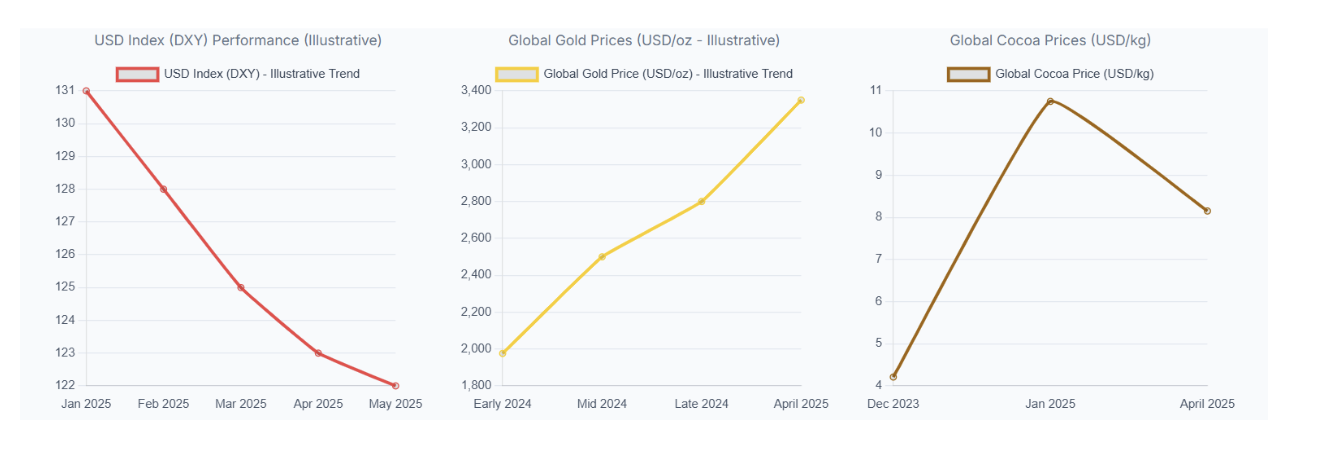
The appreciation of the Ghana Cedi is not solely due to internal production increases but is significantly amplified by a complex global interplay, particularly concerning the U.S. dollar and gold prices. Historically, there has been an inverse relationship between gold prices and the U.S. dollar’s strength: when the dollar strengthens, gold typically weakens because it becomes more expensive for holders of other currencies, and dollar-denominated assets offer more attractive yields.
However, late 2023 and early 2024 witnessed an unusual phenomenon where both gold and the dollar demonstrated significant strength simultaneously. This was influenced by factors such as geopolitical tensions, increased central bank gold purchases (as a diversification away from dollar-denominated assets), and persistent inflation concerns. A key driver for gold’s appeal was the market’s anticipation of the Federal Reserve signaling interest rate cuts while inflation remained above target. This scenario leads to lower real interest rates, reducing the opportunity cost of holding non-yielding assets like gold.
Crucially for Ghana, the US Dollar Index (DXY) has fallen by approximately 7% since the beginning of 2025. This weakening of the USD in early 2025 directly contributed to the surge in global gold prices, which surpassed US$3,300 per ounce in April 2025. This global dynamic has significantly amplified Ghana’s gold export revenues, providing a substantial foreign exchange windfall. Ghana is thus a direct beneficiary of these global macroeconomic and geopolitical trends. While its increased gold production is a domestic factor, a substantial portion of the export windfall (and thus the Cedi’s strength) is externally driven. This implies that the Cedi’s stability is partially contingent on these global factors remaining favorable, making it susceptible to shifts in international monetary policy, inflation outlooks, and geopolitical risk sentiment.
The following charts illustrate the performance of the US Dollar Index and global gold prices:
Chart: US Dollar Index (DXY) Performance (Q1 2025 – May 2025)
Balance of Payments & Reserves
Ghana’s improved external accounts are evident in a record provisional current account surplus of US$2.1 billion in the first quarter of 2025. This surplus was primarily “driven mainly by higher prices and increased production volumes of gold and cocoa, and strong remittance inflows”. The strong current account performance, even with net outflows in the capital and financial account, resulted in an overall Balance of Payments surplus of US$1.1 billion.
This robust external performance has translated into significant reserve accumulation. Gross International Reserves (GIR) climbed from approximately US$6.0 billion in early 2024 to nearly US$10.7 billion by April 2025. This level is equivalent to 4.7 months of import cover, a substantial improvement from about 2.7 months in early 2024. The Bank of Ghana explicitly states that this reserve accumulation is “largely from domestic sources”, implying that the Cedi’s strength is genuinely market-driven and not a result of depleting reserves to prop up the currency. The significant increase in Ghana’s import cover provides a crucial buffer against external shocks, signaling enhanced economic resilience and effectively reducing speculative pressure on the Cedi by reassuring markets of ample foreign exchange liquidity. A robust reserve position instills confidence among investors and market participants, signaling that the central bank possesses sufficient foreign exchange resources to manage potential demand-supply imbalances in the currency market, thereby discouraging speculative attacks against the Cedi. This reduces the perceived risk of currency depreciation and contributes directly to the Cedi’s stability and appreciation.
The following chart illustrates the trend in Ghana’s Gross International Reserves and import cover:
 Policy and Central Bank Actions
Beyond favorable macroeconomic trends, Ghana’s authorities have implemented a series of decisive policy measures that have been instrumental in supporting the Cedi’s appreciation and ensuring macroeconomic stability.
Tight Monetary Policy (Ghana)
The Bank of Ghana (BoG) has consistently maintained a hawkish monetary policy stance. The Monetary Policy Rate (MPR) was held at 28.0% in May 2025 by a unanimous decision, following a 100 basis points hike to 28% on March 28th, 2025, after three consecutive meetings with no changes. This tight policy stance, coupled with stepped-up liquidity sterilization efforts, has been explicitly credited by BoG Governor Johnson Asiama for the Cedi’s recent rebound and for its role in bringing down inflation.
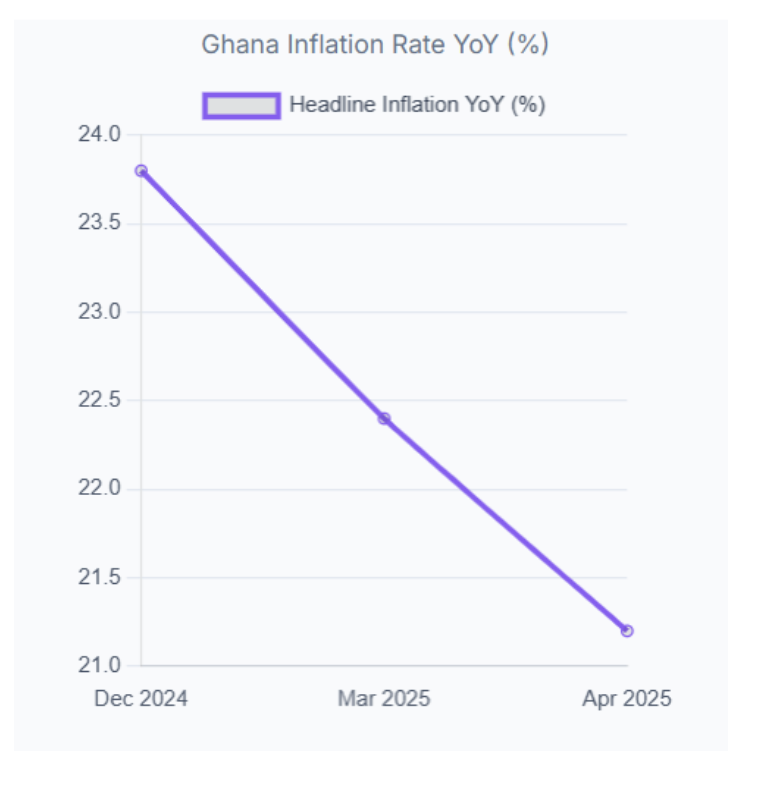
Headline inflation has declined consecutively for four months, reaching 21.2% in April 2025, a significant drop from 23.8% in December 2024. Both food inflation (25.0% in April) and non-food inflation (17.9% in April) have eased. The Ghana Reference Rate, which serves as the base lending rate, has eased substantially to 23.9% in April 2025 from 29.3% in December 2024, signaling improvements in credit conditions and potentially boosting real sector activities.
Despite these positive developments, the BoG acknowledges that the current inflation level remains high relative to its medium-term target of 6%-10%, necessitating a continued tight stance to reinforce the disinflation process. Inflation is now expected to ease faster towards the medium-term target, potentially by Q1 2026, barring unanticipated shocks.
The Bank of Ghana’s decision to maintain a high Monetary Policy Rate (MPR) at 28.0% despite a consecutive decline in headline inflation demonstrates a robust commitment to anchoring disinflation and reinforcing exchange rate stability, prioritizing long-term price stability over immediate growth stimulation. This continued hawkish stance, even as inflation shows signs of easing, indicates a strong resolve to fully achieve its inflation target and solidify the Cedi’s gains. This signals to the market that the central bank is not prematurely easing policy and is committed to breaking inflationary inertia, even if it means potentially moderating short-term economic growth. This proactive approach enhances the BoG’s credibility and reinforces market confidence in the Cedi’s stability.
The following chart illustrates the trend in Ghana’s inflation rate:
Chart: Ghana Inflation Rate (YoY) (Historical Trend)
Fiscal Discipline
The government’s budget performance has shown improvement, with fiscal policy implementation broadly aligned with the 2025 Budget. Provisional data for Q1 2025 indicated a primary surplus on a commitment basis, a significant step towards fiscal consolidation. Revenue shortfalls were effectively offset by spending cuts and expenditure rationalization, contributing to closing the deficit and signaling fiscal discipline to financial markets.
The Cedi’s appreciation has had a profound positive effect on Ghana’s fiscal health. President John Mahama announced that the Cedi’s strength had already reduced Ghana’s foreign-currency debt by nearly ₵150 billion over the past five months. This has created much-needed fiscal breathing room, potentially allowing Ghana to achieve its target of a 55–58% debt-to-GDP ratio by year-end, well ahead of the original 2028 deadline. Public debt, using the revised GDP series, fell from approximately 69% of GDP in early 2024 to roughly 55% by early 2025. The Cedi’s appreciation is creating a powerful virtuous cycle for Ghana’s fiscal health by significantly reducing the local currency cost of its substantial external debt, thereby freeing up critical fiscal space that can be strategically redirected towards growth-enhancing projects. The newly created fiscal space allows the government to reallocate funds (potentially up to 15% of previous debt-service outlays) towards crucial capital projects such as infrastructure, healthcare, and education. This redirection of resources can stimulate real economic growth, create jobs, and improve public services, thereby further strengthening the Cedi’s long-term fundamentals and fostering a positive feedback loop between currency stability and economic development. The government has renewed its commitment to the IMF’s Extended Credit Facility (ECF) program, which is crucial for continued support and external confidence.
Central Bank Interventions
The Bank of Ghana has actively enforced foreign exchange rules, monitoring interbank and bureaux-de-change operations. Initiatives like the relaunched Gold Purchase Programme and a new gold-backed bond aim to ensure export proceeds enter the official market. Importantly, reserves have grown, implying the Cedi’s strength is market-driven, not due to reserve depletion (though BoG did support the FX market with US$264.4M in March 2025 to preserve stability).
Will the Cedi’s Rally Continue?
The sustainability of the Cedi’s recent gains is a subject of ongoing analysis, with arguments for both persistence and potential headwinds.
Arguments for Persistence
Fundamental economic improvements strongly suggest that the Cedi’s positive trend may persist. The underlying enhancements in Ghana’s external accounts, driven by record gold and cocoa exports and robust remittance inflows, continue to facilitate the accumulation of international reserves. This has led to a substantial increase in import cover, providing a crucial buffer against external shocks.
Policy consistency further supports this outlook. Both fiscal and monetary policies remain tight and disciplined. The Bank of Ghana maintains its hawkish stance, and its latest forecast points to inflation returning faster to target (by Q1 2026) if these policies hold. The government’s renewed commitment to fiscal consolidation under the IMF program is also a positive sign, providing a framework for continued stability and external support.
Investor confidence appears to be growing following last year’s crisis. S&P Global Ratings recently raised Ghana’s foreign currency sovereign credit ratings to ‘CCC+/C’ from ‘SD/SD’ in May 2025, with a stable outlook, citing improving external metrics and resilient economic growth. The IMF has also reached staff-level agreements on reviews of its Extended Credit Facility, signaling continued international backing. Furthermore, Ghana could see an additional surge in remittances if the proposed U.S. 5% remittance tax prompts Ghanaian migrants to send funds home before it takes effect, providing a temporary boost to inflows.
Risks and Headwinds
Despite the positive momentum, several risks and headwinds could challenge the Cedi’s rally. Economists, such as Lord Mensah, caution that the recent Cedi strength “is not going to run forever” without sustained growth in Ghana’s “real sectors” (e.g., agriculture, manufacturing, and diversified services). A significant portion of the appreciation so far reflects financial inflows and past policy tightening, rather than broad-based productive expansion. This observation highlights that while Ghana’s immediate currency strength is largely driven by robust financial inflows (commodity exports, remittances) and tight policy, its long-term sustainability is critically dependent on translating these financial gains into tangible, diversified real sector growth. Without this, the Cedi’s rally risks becoming a reprieve, potentially exposing Ghana to “Dutch Disease” effects, where a booming commodity sector makes other export sectors less competitive due to a strong currency, hindering long-term economic diversification and creating vulnerability to commodity price downturns.
Commodity price volatility also poses a risk. While currently favorable, global prices for gold and cocoa are subject to fluctuations. If these prices fall significantly, or if Ghana’s oil output faces maintenance shutdowns in Q3, the Cedi could weaken. Cocoa prices, for instance, have already retreated slightly in May 2025 after peaking earlier in the year.
Fiscal spending pressures remain a concern. Although the 2025 budget aims for strict expenditure control and a primary surplus, expenditure pressure is likely to persist due to factors such as high inflation, potential public discontent with public financial management, and the inherent risks this poses to economic growth. Historically, Ghana’s expenditure has grown substantially (28% annually over the past 25 years).
There are also indications that many firms priced goods in Cedi at earlier, higher exchange rates, meaning consumer prices may not yet fully reflect the stronger currency. While inflation is declining, it remains elevated at 21.2% in April 2025, still significantly above the Bank of Ghana’s target range. Furthermore, while the banking sector has shown resilience, asset quality remains a concern, with the non-performing loan (NPL) ratio climbing to 21.8% by year-end 2024 from 20.6% a year prior. Recapitalization measures are still required for some banks to ensure continued resilience.
External headwinds also persist. Global economic developments continue to present challenges, including low growth prospects, unsynchronized disinflation outcomes, and restrictive global financial conditions, partly driven by trade policy shifts in the United States. The World Bank also cautions about downside risks such as a sharper-than-expected slowdown in China, escalating geopolitical tensions (particularly in the Middle East), and prolonged elevated global interest rates.
Forecast/Conclusion
The Ghana Cedi is likely to remain relatively strong and stable in the near term, specifically over the next month to the next quarter. The momentum from continued high global commodity prices (especially gold, buoyed by global uncertainties and ongoing central bank demand for diversification), sustained robust remittance inflows, and the Bank of Ghana’s unwavering commitment to its tight monetary policy stance will provide significant and credible support. The ongoing adherence to the IMF program and the recent sovereign credit rating upgrade by S&P Global Ratings will further bolster investor confidence. The central bank’s ample reserve buffers (US$10.7 billion, equivalent to 4.7 months of import cover) provide a strong and credible defense against any immediate speculative pressures or short-term external shocks.
While the broad appreciating trend is expected to persist, minor fluctuations are possible. These could arise from short-term shifts in global commodity prices (e.g., the recent retreat in cocoa prices 1), or any perceived softening in the government’s fiscal discipline. However, given the current policy resolve and the fundamental improvements in the external sector, these are unlikely to trigger a sharp or sustained reversal in the immediate horizon. The trajectory of global gold and cocoa prices, the actual implementation and market reaction to the proposed U.S. remittance tax, and the Ghanaian government’s continued strict adherence to its fiscal consolidation plan will be crucial determinants of the Cedi’s path. The pace of inflation decline and the Bank of Ghana’s corresponding policy responses will also be closely watched.
As highlighted by economists, the longer-term sustainability of the Cedi’s strength beyond the next quarter will increasingly depend on Ghana’s ability to translate these substantial financial inflows into diversified real economic growth, moving beyond an over-reliance on commodity windfalls. The current rally presents a valuable window of opportunity for targeted investments in non-commodity sectors to ensure a more resilient and sustainable foundation for the Cedi’s value in the long run.