



The OPEC+ Cartel Is Breaking — Right When the Market Needs It Most
May 6, 2026 by johneb492254456
The unexpected announcement that the United Arab Emirates (UAE) will leave OPEC (effective May 1) has exposed deep fractures in the once-unified oil cartel. As one of the group’s largest producers, the UAE’s departure “weakens OPEC’s control over global oil supplies”. This comes at a time when the world is experiencing an unprecedented energy shock. Gulf exports are being choked by a war-induced shutdown of the Strait of Hormuz, and global oil prices have surged. Under normal circumstances, OPEC+ would be expected to manage supply and stabilize markets. Instead, coordination is visibly fraying. In short, the mechanisms designed to stabilize the market are becoming less reliable precisely when stability is needed most.
OPEC was founded to coordinate production among oil exporters, holding roughly 40% of the world’s oil reserves and stabilizing prices. The UAE exit highlights a shift from collective discipline to national strategy. With the UAE gone, one of OPEC+’s few members with significant spare capacity is no longer bound by quotas. As Rystad Energy analyst Jorge Leon explains, OPEC becomes “structurally weaker…with less spare capacity,” making it harder to calibrate supply and stabilize prices. In practical terms, the cartel will struggle to coordinate responses to future shocks. Other members may take this as a sign that they too can prioritize their own production goals over group targets, further fragmenting global supply.
The rupture in coordination coincides with a physical supply shock in the Persian Gulf. Iran’s war effort has essentially closed the Strait of Hormuz, through which about 20% of the world’s oil normally passes. According to the IEA, “global supply plummeted by 10.1 million barrels per day to 97 mb/d in March,” as tanker movements through Hormuz were choked off. Gulf producers like Saudi Arabia, Kuwait, and the UAE are producing oil but cannot export most of it. In effect, production is stuck at the wellhead. As Pepperstone strategist Michael Brown notes, for now “all that really matters is whether the Strait of Hormuz is open or closed” – it is essentially closed, tightening supply and pushing prices ever higher.
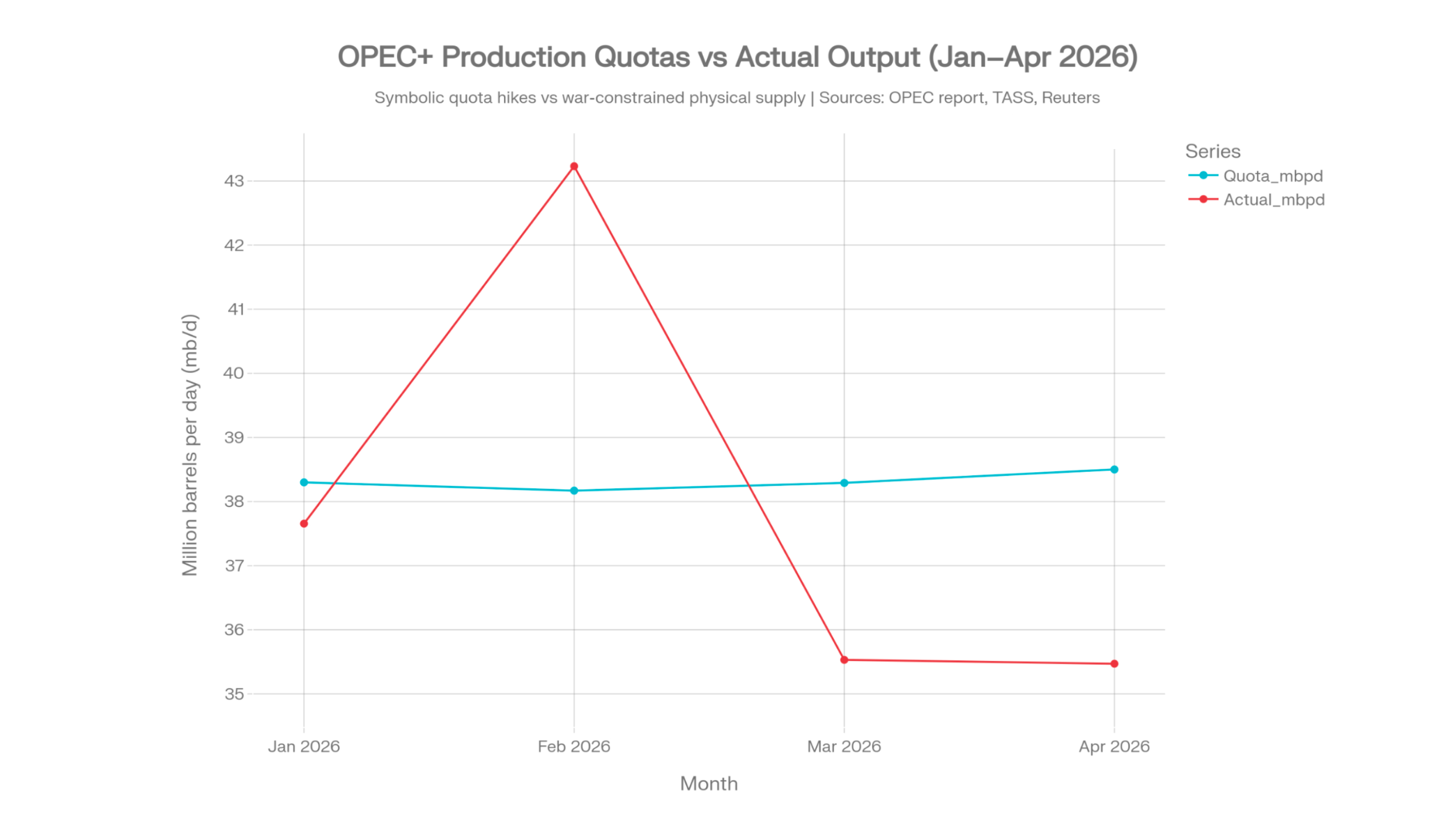
OPEC+ leaders have responded by pledging small output increases. In early May they agreed to raise June quotas by about 188,000 barrels per day. However, these hikes are largely symbolic. With Hormuz closed and key producers cutting output, the actual flows remain far below quota levels. OPEC data show that combined OPEC+ output plunged to 35.06 mb/d in March (from 42.76 mb/d in February) due to war-related disruptions. In practice, the group is signaling a readiness to boost supply once the crisis ends, but right now most members cannot physically deliver the oil they have agreed to produce.
 Global oil prices have responded to this turmoil. Brent crude recently spiked above $125 per barrel, marking the biggest monthly gain on record. Analysts attribute this not to fundamental demand growth, but to the physical squeeze caused by blocked exports. With OPEC+ unable to release “spare” barrels into the market, any supply shortfall shows up directly in prices. The disconnect between policy and delivery means oil benchmarks have surged roughly $60/bbl above pre-war levels. In short, market confidence in OPEC+’s ability to stabilize prices has diminished, making the oil market more reactive to short-term events.
With the UAE free from OPEC quotas, the country can pursue its own production strategy. Officials have already signaled plans to incrementally raise output when exports resume. Other Gulf producers may follow suit. This marks a shift from group discipline to national strategy: each country will seek to maximize market share and revenue, especially if peak oil demand looms. As one analyst notes, leaving OPEC “opens the door for the UAE to gain global market share when the geopolitical situation normalises”. In effect, oil markets are moving from a coordinated cartel model to something more akin to competitive oligopoly, increasing the chances of price swings.
In conclusion, the twin shocks of the Hormuz blockade and the UAE’s departure signal a shift toward fragmentation. Oil markets are now more prone to volatility because the key stabilizer (OPEC+) is weakened. Rather than an immediate market collapse, expect weaker signaling power and more unpredictable swings. Policymakers and traders will watch the Strait of Hormuz and individual country output more than OPEC communiques. As Rystad Energy’s Jorge Leon warns, with a “more fragmented supply landscape… OPEC’s capacity to smooth imbalances diminishes” and markets become inherently more volatile over time. At this historic juncture, the very mechanisms meant to dampen shocks are being tested at their limits.