



Stablecoins vs. Bank Wires: The Real Cost & Speed for Business
June 1, 2026 by Diadem Akhabue

In the world of global commerce, “the check is in the mail” has been replaced by “the wire is in flight.” But for many finance teams, that flight feels less like a modern jet and more like a hot air balloon—slow, unpredictable, and subject to the whims of every passing breeze (or intermediary bank).
As businesses scale across borders, the friction of moving capital becomes a silent killer of growth. At WeWire, we talk to CFOs daily who are frustrated by the lack of transparency in international wire transfer speed and the sheer opacity of bank transfer fees. The conversation is shifting. It’s no longer just about how we send money; it’s about whether the legacy rails we’ve used for fifty years are still fit for purpose. Enter the stablecoin.
The Legacy Wall: Understanding the Real Cost of Bank Wires
When you initiate a traditional bank wire (SWIFT), you aren’t just sending money from Bank A to Bank B. You are navigating a relay race. Because most banks don’t have direct relationships with every other bank on earth, they use “correspondent banks.” Each runner in this relay takes a small “handling fee” out of the principal before passing it on.
- The Hidden “Vampire” Fees
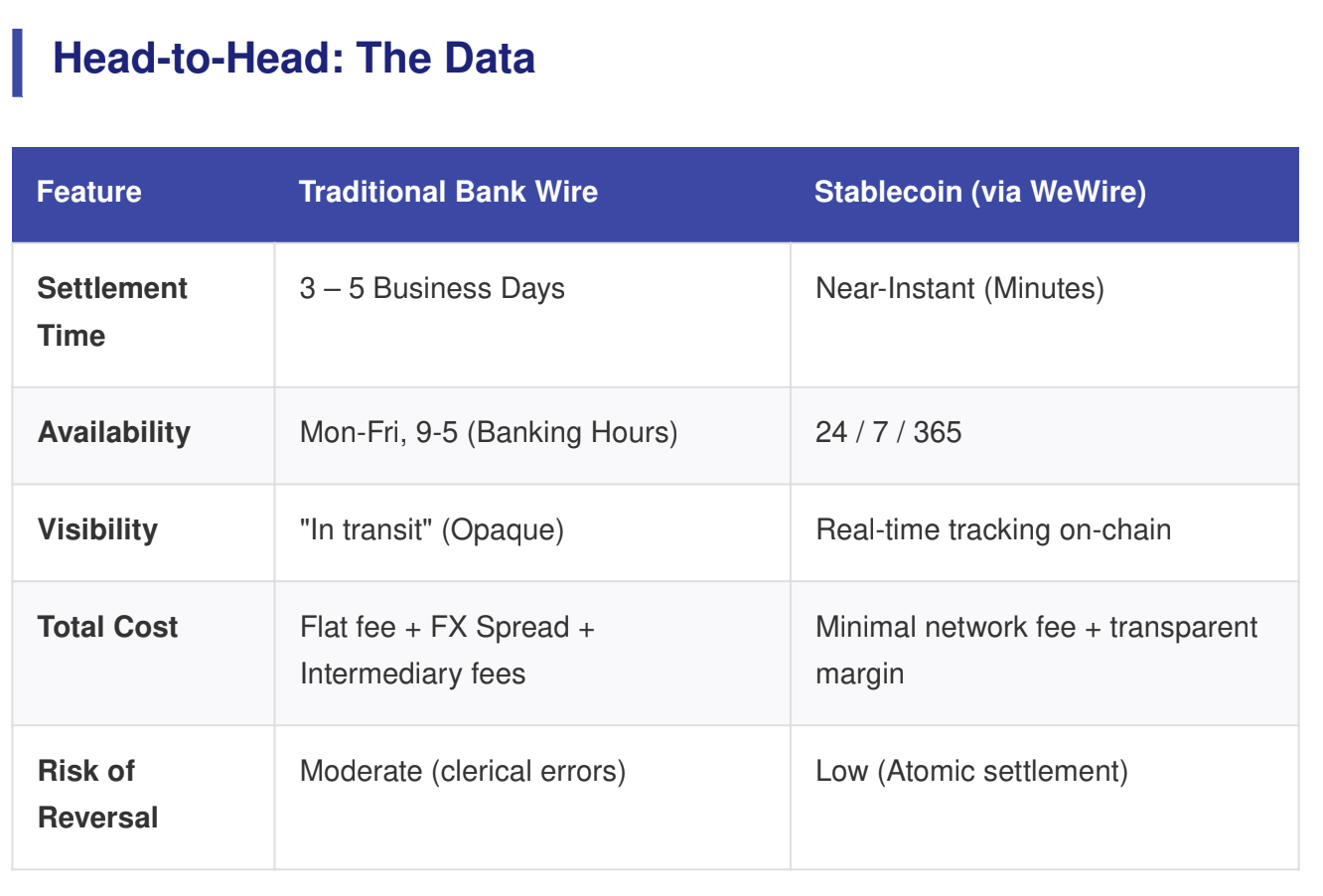
The advertised flat fee (often $35–$50) is rarely the total cost. The stablecoin vs bank wire debate starts here. A business might lose 1% to 3% on the FX spread alone. If you are moving $100,000 to pay a manufacturer in Vietnam, a 2% spread is a $2,000 “ghost fee” that never appears on an invoice but vanishes from your bottom line.
2. The Speed Trap
Traditional international wire transfer speed is governed by “business days” and “banking hours.” If you send a wire on Friday afternoon from New York to Singapore, it effectively disappears into a black hole until Monday morning. For a supply chain that depends on “Just-in-Time” delivery, a three-day delay in payment confirmation can mean a week-long delay in shipping. “Efficiency isn’t just about saving a few dollars on fees; it’s about capital velocity. Money sitting in a correspondent bank’s ‘pending’ queue is dead capital.”
Stablecoins: The Digital Highway
Stablecoins, like USDC or USDT, are digital assets pegged 1:1 to a fiat currency (usually the USD). They live on the blockchain, which operates 24/7/365. When comparing stablecoin vs bank wire, the fundamental difference is architecture. One is a series of ledger updates across multiple private entities; the other is a single, instant cryptographic transfer on a public or semi-public rail.
Real-World Use Case: The Agile Importer
Consider GlobalGoods Inc., a mid-sized electronics distributor. They need to secure a limited batch of components from a supplier in Dubai. Using a bank wire, they initiate the transfer on Tuesday. The supplier sees the funds on Friday. By then, the stock is gone. With WeWire’s stablecoin integration, GlobalGoods Inc. sends the payment. The transaction hits the blockchain and is confirmed within minutes. The supplier receives a notification, locks in the inventory, and ships the same day. That is the competitive advantage of speed.
The WeWire Difference: Bridging the Two Worlds
While the benefits of stablecoins are clear, many businesses hesitate because of the perceived complexity. This is where WeWire comes in. We don’t just provide a “crypto wallet”; we provide a sophisticated financial interface that makes stablecoins feel like the banking experience you’re used to, just better this time.
Compliant & Secure
One major hurdle for businesses is the “compliance gap.” Traditional banks are terrified of crypto, and for good reason, regulation has been a moving target. WeWire bridges this by maintaining rigorous KYC (Know Your Customer) and AML (Anti-Money Laundering) standards. When you use WeWire, you get the speed of the blockchain with the institutional-grade security of a Tier-1 financial service.
Direct Comparison: Settlement Logic
In a bank wire, settlement is “probabilistic”—you hope it gets there. In a stablecoin transfer via WeWire, settlement is “deterministic.” The math is simple:

For a CFO managing cash flow, reducing that variable from days to minutes changes everything from liquidity planning to vendor relationships.
Why Now? The Cost of Inaction
We are entering an era of “Real-Time Finance.” As consumer payments (like Venmo or Pix) become instant, B2B payments can no longer afford to be the laggard. The bank transfer fees you pay today aren’t just line items; they are a tax on your ability to compete globally. Transitioning to stablecoin-based settlements doesn’t mean abandoning your bank. It means adding a high-performance engine to your treasury department. It means knowing that when you hit “send” at 10 PM on a Sunday, your partner across the globe is getting paid at 10:05 PM.
Ready to upgrade your capital velocity?
Stop waiting for the “next business day.” Discover how WeWire can slash your international transfer times and eliminate hidden fees today.