



The Modern Economy Runs on People Pretending They’re Financially Fine
May 27, 2026 by johneb492254456
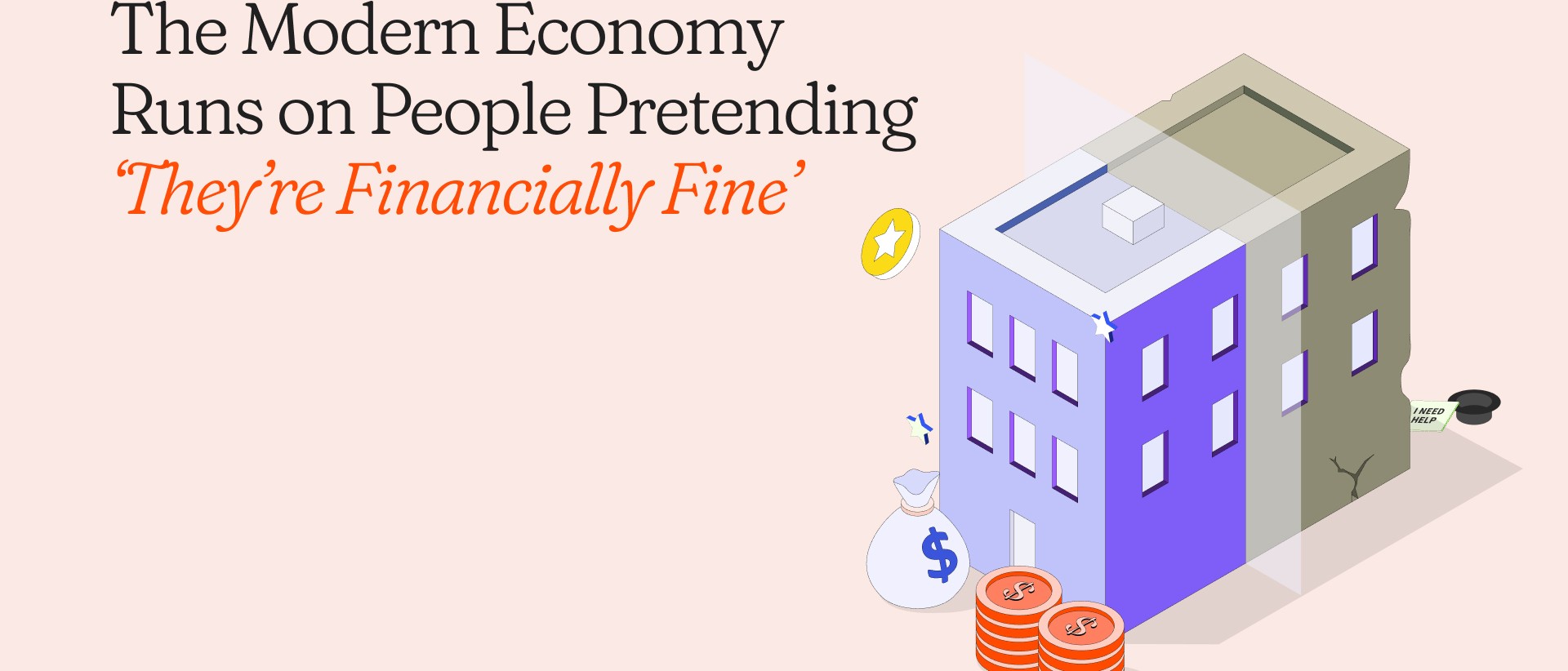
The Modern Economy Runs on People Pretending They’re Financially Fine. This StayWired presentation analyzes the widening disconnect between robust visible consumer activity and deepening household financial fragility across advanced and emerging economies. While global consumption continues to expand and support macroeconomic activity, data from the IMF, OECD, and World Bank reveal that many households sustain spending through debt and trade-offs amid slowing real wage gains and severe housing affordability pressures. Aimed at the general public, this analysis questions whether current economic resilience reflects genuine stability or a collective performance of financial normalcy that masks underlying vulnerabilities.
Global consumer economies demonstrate continued strength as households maintain spending on travel, retail, dining, subscriptions, and digital services. World consumer spending reached approximately 60 trillion US dollars in 2023 and has shown further expansion, with projections indicating steady growth into 2025-2026 driven by both advanced and emerging markets. This visible activity sustains retail sales and digital commerce even as broader sentiment indicators fluctuate, creating an appearance of broad-based prosperity. Social media amplifies aspirational narratives, encouraging participation in consumption cycles that keep aggregate demand relatively firm across regions.
Despite ongoing consumption, real wage recovery has slowed significantly. Across OECD countries, average annual real wage growth reached 1.8 percent in Q3 2025, half the pace recorded in Q3 2024, with real wages still below early 2021 pre-inflation surge levels in half of the 37 countries analyzed. The IMF has described 2024-2025 as marking one of the worst housing affordability crises in over a decade, with home prices across OECD countries rising 37 percent in real terms since the global financial crisis while wages lagged substantially. These dynamics force many households into delayed savings and invisible trade-offs, eroding long-term financial buffers in both high-income and developing contexts.
 Households increasingly rely on credit to sustain spending patterns. Global private debt remains elevated near 143 percent of GDP according to IMF figures, with household debt stocks around 65 trillion dollars concentrated in major economies. Household debt-to-GDP ratios exceed 100 percent in countries like Canada, Australia, and Sweden, while remaining high in the US, UK, and parts of Europe. This debt-supported consumption bridges the gap created by slower income growth but builds fragility, as families prioritize short-term normalcy over resilience. In emerging markets, similar patterns add vulnerability amid uneven recovery.
Social platforms globally incentivize displays of consumption and lifestyle success, obscuring widespread financial pressures. Users across Europe, Asia, and North America share curated highlights that reinforce perceptions of stability, even as OECD surveys show heightened concerns about housing and costs among younger demographics. This projection sustains economic momentum by encouraging continued spending and borrowing, yet it widens the analytical gap between surface-level confidence indicators and actual metrics of resilience such as savings rates and debt service burdens. The result is a cultural mechanism that helps economies function through collective performance rather than uniform financial health.
The interplay produces a distinctive macroeconomic picture where aggregate consumption holds steady while household-level fragility accumulates. IMF and World Bank analyses show consumer spending supporting growth even as real incomes recover unevenly and debt levels stay high. This environment allows economies to operate normally through sustained participation and borrowing, but it raises sustainability concerns. With private debt elevated and wage growth moderating, the collective maintenance of financial appearances acts as an implicit stabilizer, potentially delaying necessary adjustments in housing policy, wage dynamics, and debt management across diverse economies.
Apparent economic strength today depends heavily on households continuing to act financially secure despite data showing persistent pressures on wages, housing, and balance sheets. For the general public, this underscores the need for greater personal awareness beyond media projections and policy focus on improving affordability and real income gains. Insights from the IMF, OECD, and World Bank suggest that bridging the gap through targeted measures on housing supply, wage support, and responsible credit could foster more authentic resilience. Without such alignment, economies risk relying longer on performative stability rather than broad-based financial security.