



Why 85% of Countries That Reach Middle-Income Status Never Become Rich
May 20, 2026 by johneb492254456
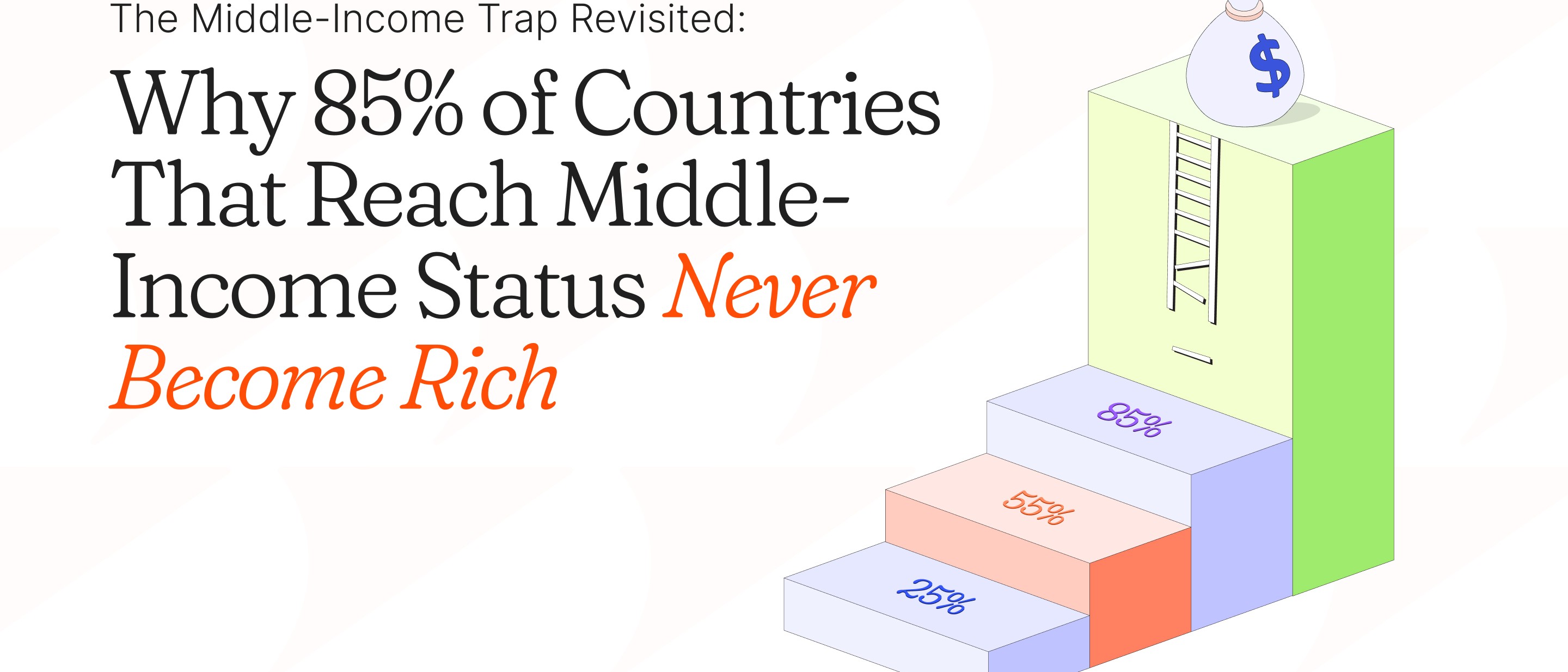
Today roughly 108 economies are classified as “middle-income” – from lower-middle to upper-middle brackets – encompassing about 6 billion people or 75% of the world’s population. These countries together generate over 40% of global GDP and two-thirds of the world’s extreme poor. Yet history shows escaping middle-income status is rare: since 1990 only 34 of these economies have graduated to high-income levels, and many of those success stories (like Poland or oil-rich Gulf states) involved special circumstances. In practice, middle-income nations tend to stall as they near per-capita incomes of roughly $8,000 (about 10% of U.S. GDP per person).
By the World Bank’s definition (GNI per capita $1,136–$13,845), the 108 middle-income countries include almost every major emerging economy (China, India, Brazil, South Africa, etc.). Together they account for 75% of humanity, produce about 40% of global output and over 60% of emissions. For example, China alone contributes a fifth of the world’s GDP and lifted hundreds of millions out of poverty – yet even China only recently crossed into the upper-middle range. This vast middle tier drives global trends: how fast these economies can grow and innovate will largely determine whether global poverty falls or persists.
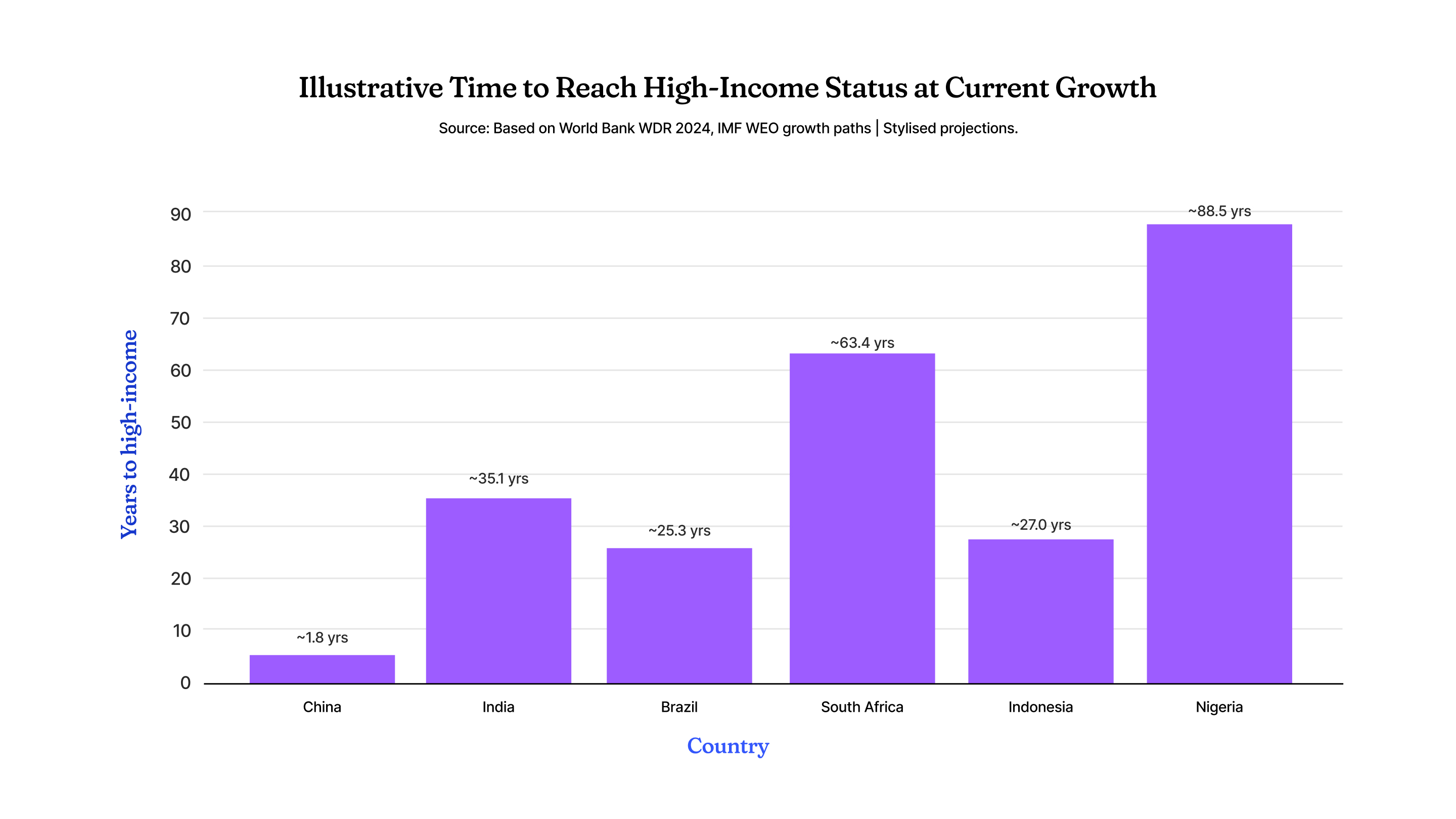 Analysts attribute the slowdown at middle-income to economic forces and policy limits. Early growth in poor countries comes from exporting labor-intensive goods, heavy capital investment, and adopting imported technologies. But as wages rise, these advantages fade: middle-income exporters lose cost-competitiveness with poorer countries, while higher-skilled, innovative sectors remain dominated by advanced economies. The World Bank finds growth slowdowns are much more common in middle-income economies than in low-income or high-income ones. The IMF similarly notes many such countries find themselves “caught between the rapidly changing advanced technology of rich countries, and competition in mature products from poor countries with low wages”. In short, traditional development strategies (investment in capital and infrastructure) yield diminishing returns in this phase. Weak institutions and skills gaps compound the problem, making it hard to shift into a higher-technology growth mode.
A few nations have bucked the trend by methodically transforming their economies. South Korea is the standout example: in 1960 its per-capita income was only about $1,200, but by 2023 it reached roughly $33,000. Seoul did this by sequentially following the “3i” path. First it spurred heavy public and private investment in infrastructure and industry. In the 1970s and 1980s it then encouraged firms to import foreign technology (licensing TVs and semiconductors from Japan) and move up the value chain. To support this, Korea massively expanded higher education and R&D. By the 2000s Korean companies (Samsung, LG, etc.) were global innovators. Other examples include Poland (productivity gains from EU integration) and Chile (importing Norwegian salmon-farming know-how to build a new export industry). These success cases show that with the right policies – investment plus technology transfer, then innovation – sustained convergence is possible.
Most middle-income countries still face structural hurdles. Weak institutions, lack of competition and burdensome regulations often hold back productivity. For example, countries like Brazil and South Africa have struggled to diversify beyond commodities and basic manufacturing, partly due to persistent inequality and labor-market rigidities. Middle-income leaders also confront demographic headwinds (population aging sooner than past Asian “tigers” did) and fiscal pressures. Politically, powerful incumbents (large firms or elites) can block reforms that would increase competition and innovation. In practice, many nations remain “wedded to an approach out of the last century,” relying too long on investment-driven growth and neglecting new technologies. This policy inertia locks in the trap: countries become too expensive to compete in labor-intensive industries yet too weak in innovation to jump into high-tech sectors.
The new World Bank analysis lays out a sequenced “3i” strategy to break out. Low-income countries should start with an investment-led strategy (1i), building infrastructure and basic education. After reaching lower-middle-income status, economies should “shift gears” to a mix of investment plus infusion of foreign technology (2i). This means actively adopting and diffusing cutting-edge technologies – for instance through licensing agreements, joint ventures, or training programs – while continuing to expand capital. In the upper-middle-income phase, countries must add a strong focus on innovation (3i): reshaping markets, labor and energy use to encourage homegrown R&D and creative entrepreneurship. Importantly, this strategy is cumulative rather than sequentially exclusive. South Korea’s history illustrates it: only after decades of capital and technology-building did Seoul liberalize its economy and invest aggressively in high-tech innovation. In short, escaping the trap requires combining investment with education, open trade, competition policy and R&D reforms all at once.
In the next decades, global prosperity hinges on how these countries fare. The World Bank warns that middle-income economies will have to pull off near “miracles” to reach high-income status under current conditions. With rising debt, geopolitical tensions and climate challenges, there is little room for error. The Chief Economist Indermit Gill cautions that success demands a “fresh approach” – those who keep “driving in first gear” (investment alone) will never close the gap. If middle-income governments embrace the full 3i roadmap – strengthening education and governance, integrating into global markets, and fostering innovation – many can avoid stagnation. But if they rely on old growth recipes, hundreds of millions will remain poor while inequality rises. Ultimately, whether the majority of these countries beat the trap or not will shape global inequality and growth into mid-century.