



Central Banks Are Fighting Inflation at 12% While Stablecoins Peg at 1:1 — Who’s Winning Trust?
September 24, 2025 by johneb492254456

Central banks globally have embarked on aggressive rate hikes to tame rising prices. According to the IMF, world inflation surged to about 8.7% in 2022 before easing towards roughly 5% by 2024. In high-inflation economies, however, many citizens feel prices rising far faster. Stablecoins – cryptocurrency tokens pegged 1:1 to fiat dollars or euros – have become prominent alternatives. Unlike volatile crypto, stablecoins are explicitly designed “to preserve value” by holding reserves of real currency. This week’s StayWired explores how people’s trust is shifting: when local currency loses value daily, are dollar-backed tokens winning confidence?
High inflation is not just a number – it’s a painful reality for consumers. For example, Nigeria’s currency lost roughly 40% of its value in 2023, effectively wiping out savings, and Zimbabwe continues to suffer triple-digit inflation. Central banks have responded by pushing interest rates to multi-year highs to rein in prices. The IMF notes that the global policy rate has been lifted aggressively; world inflation is forecast to fall from 8.7% (2022) to about 6–7% in 2023 and into the 5% range by 2024. Despite this, many countries still see double-digit inflation, undermining trust in fiat currency.

In response, stablecoins have taken off as a “digital dollar” for the unbanked and those fleeing inflation. Stablecoins are crypto tokens whose value is backed by reserves (cash, bonds, etc.) so that 1 coin = 1 dollar. The market is dominated by tokens like Tether’s USDT and Circle’s USDC. An IMF analysis of $2 trillion in global crypto flows finds that Africa and the Middle East alone saw over $200 billion in stablecoin activity in 2024. Notably, USDT and USDC make up roughly 57% and 43% of that regional volume respectively. In fact, stablecoin transaction volume in Africa last year was equal to about 6.7% of GDP. Most of these transfers are cross-border – only about 14% of flows stay local – reflecting use in remittances and trade where banks are costly or slow.
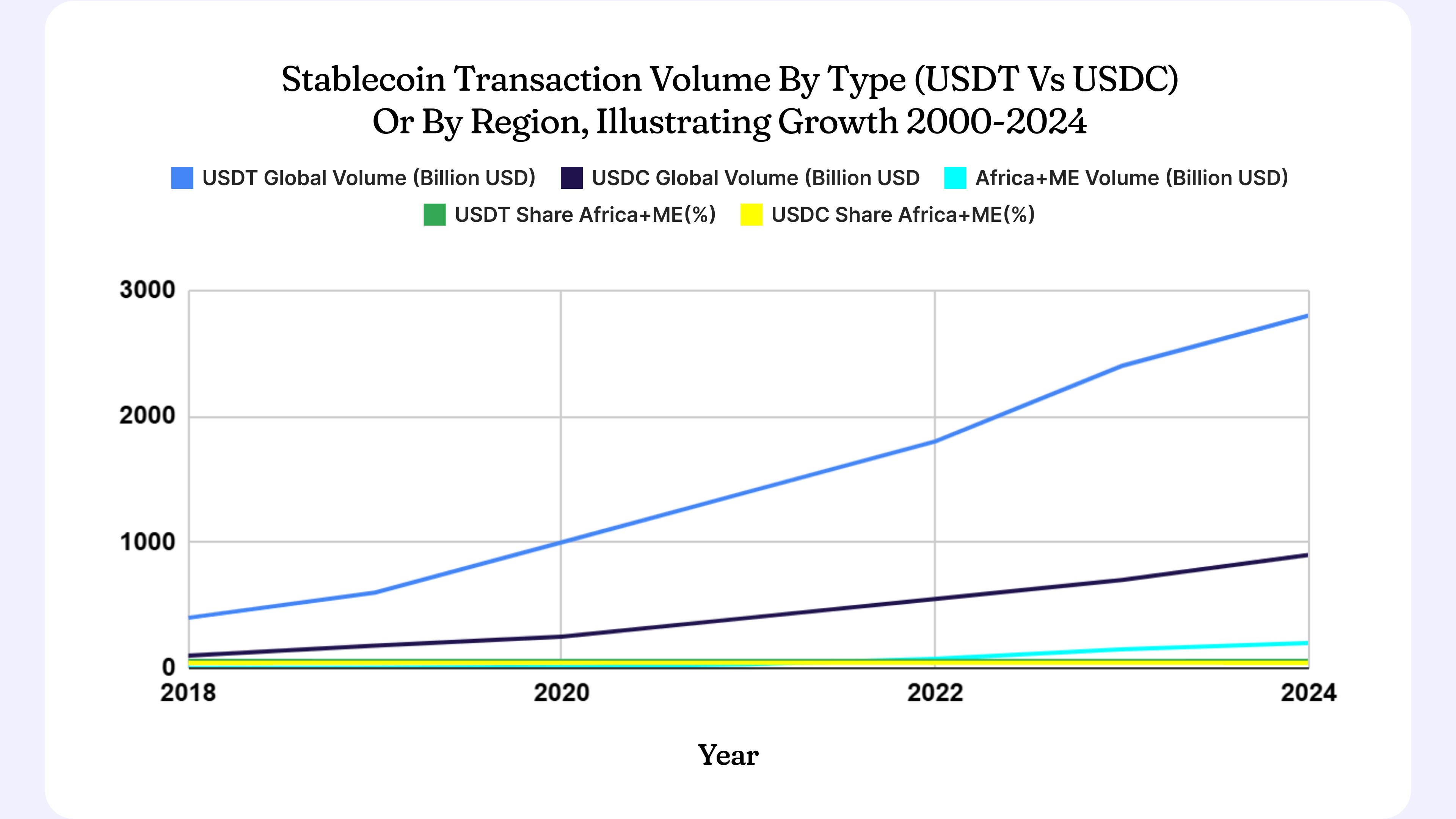
In many African markets, stablecoins now dominate crypto activity. For instance, Chainalysis reports that stablecoins accounted for roughly 43% of all crypto transaction value in Sub-Saharan Africa during mid-2023, far surpassing Bitcoin’s share. In Nigeria – Africa’s largest crypto market – over 70% of crypto trades are stablecoins, as citizens protect wealth against naira devaluation. Industry experts note that in this environment, stablecoins effectively serve as a “proxy for the dollar,” enabling businesses to continue operating when local FX is scarce. These data suggest that users are placing more trust in dollar-pegged tokens than in their own rapidly inflating currency.
Over the 2020–2025 period, inflation and stablecoin usage have both spiked – but in opposite directions on trust. Global inflation climbed from pandemic lows to nearly 9% in 2022 and is only gradually falling. Meanwhile, crypto markets have grown dramatically. Chainalysis and IMF data show global crypto transaction volume reached $2 trillion in 2024, largely fueled by stablecoins. Stablecoins themselves are expanding: one analysis projects their market cap could reach $2 trillion by 2028. In short, as inflation expectations jumped in 2021–22, demand for stablecoins surged in many regions.
For many Africans, the inflation-stablecoin story is very tangible. Countries that saw severe currency crises also saw huge jumps in stablecoin use. Ethiopia’s birr lost about 30% of its value in mid-2023, and in that period retail stablecoin transfers in Ethiopia jumped by roughly 180% year-over-year. The data show Ethiopia (+180%), Zambia (~+140%), and several others with double-figure gains. This matches on-the-ground reports: in Nigeria (inflation ~40% in late 2022) and Zimbabwe (hyperinflation), people turn to USDT/USDC to stabilize savings. For example, Ghanaian importers use stablecoins to bypass foreign currency shortages, and small traders in Kenya or Sudan use them for remittances and payment processing. The trend is clear: where local money fails, dollar-linked digital coins become the trusted alternative.
Trust is shifting in Africa as inflation erodes confidence in local currencies. Stablecoins offer lower remittance costs and a fixed dollar peg, making them attractive in the short term. Yet they carry risks, as their credibility rests on transparent reserves. Central banks are responding with regulation and digital currency experiments to rebuild trust. The real test lies in whether fiat can restore price stability or stablecoins can maintain solid backing. Either way, this cycle is redefining what money people trust.