



How Rules of Origin Are Distorting Global Commerce
February 4, 2026 by johneb492254456

Global trade is often discussed in terms of tariffs, trade wars, and geopolitical alliances, yet some of the most powerful forces shaping commerce operate quietly in the background. Rules of Origin sit at the center of this unseen architecture. They determine which goods qualify for trade benefits and which do not, influencing prices, supply chains, and access to markets without ever making headlines. As global production becomes more fragmented, these rules increasingly shape trade outcomes in ways most consumers and businesses never fully see.
Rules of Origin exist to define the national identity of goods in a world where production spans borders. They establish criteria to determine whether a product is considered domestic or foreign for tariff, quota, and trade preference purposes. These criteria can be based on where a product was last substantially transformed, the amount of local value added, or whether specific manufacturing processes occurred within a member country of a trade agreement. Institutions such as the World Trade Organization and regional trade blocs emphasize that these rules are essential for preventing trade deflection.
In today’s trade environment, Rules of Origin increasingly distort decision-making. Companies often reorganize production not to improve efficiency or reduce costs, but to satisfy technical origin thresholds. Manufacturing steps may be relocated solely to qualify for preferential treatment, even if this increases operational complexity. Bloomberg trade analysis has highlighted how firms absorb higher logistics and compliance costs simply to avoid losing tariff advantages. This shift creates a paradox where compliance strategy overrides economic logic. Trade outcomes become less about productivity and more about legal interpretation.
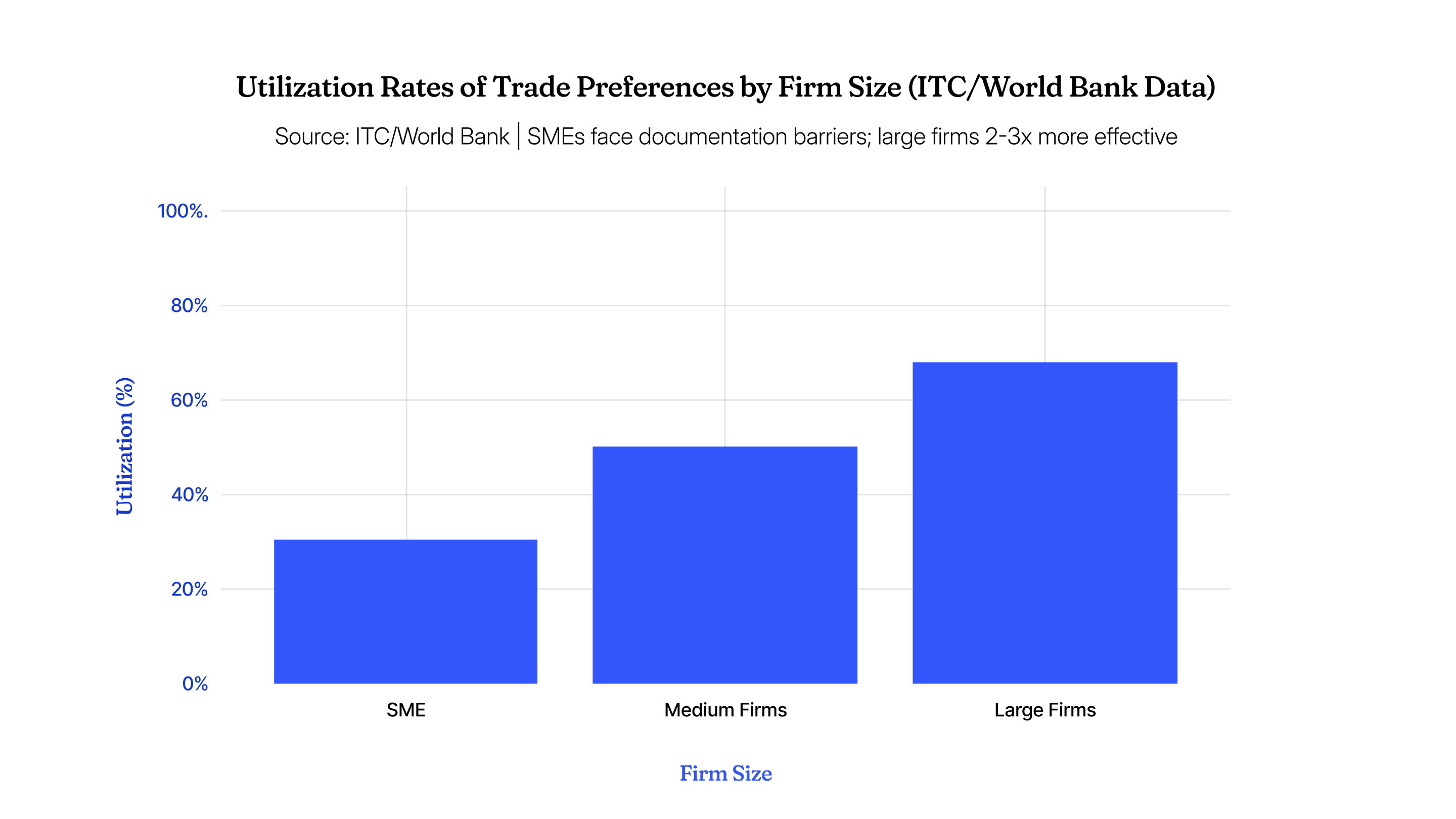
Large multinationals often have the legal teams and trade specialists needed to navigate complex origin requirements. Smaller exporters and importers do not. Reports from the International Trade Centre show that small and medium-sized enterprises are significantly less likely to utilize trade preferences because of documentation burdens and uncertainty around compliance. As a result, the benefits of free trade agreements accrue unevenly. This imbalance quietly reinforces market concentration. Firms with scale and regulatory expertise gain an advantage, while smaller players face higher effective trade barriers. In this way, Rules of Origin shape not only cross-border trade flows but also competition within markets.
 Beyond commerce, Rules of Origin have taken on strategic importance. Governments increasingly use them to influence supply chain geography without issuing explicit bans. By tightening origin requirements or redefining what constitutes sufficient transformation, countries can reduce dependence on certain regions while remaining aligned with international trade rules. Policy analysis from think tanks such as the Peterson Institute and Bruegel has shown how these mechanisms subtly redirect sourcing away from politically sensitive suppliers. This approach allows states to pursue economic security objectives quietly.
The growing influence of Rules of Origin reflects a broader shift in global trade. Market access is no longer determined solely by price or quality but by regulatory alignment and administrative precision. IMF and World Bank assessments increasingly note that non-tariff measures now pose greater barriers to trade than tariffs themselves. Rules of Origin sit squarely within this category. For consumers, this contributes to higher prices and fewer choices. For businesses, it introduces uncertainty and raises the cost of cross-border expansion. Trade becomes slower, more fragmented, and more dependent on legal interpretation than economic fundamentals.
As global trade agreements expand and supply chains continue to reconfigure, Rules of Origin will play an even larger role in determining who benefits from globalization and who does not. Understanding these rules is no longer limited to trade lawyers or customs officials. It has become essential knowledge for manufacturers, importers, policymakers, and even consumers trying to understand why goods cost more or arrive later.
The future of trade will not be shaped only by grand geopolitical statements or headline-grabbing tariffs. It will be shaped in the fine print, where Rules of Origin quietly decide access, advantage, and exclusion in the global economy.