



Knowledge Is Everywhere — Insight Is Now the Rare Asset
March 25, 2026 by johneb492254456

In the digital age, the barrier to information has effectively collapsed. Over the last two decades, connectivity has spread globally (well over half the world’s population now uses the internet), and devices constantly generate real-time news, social feeds, market data, and analytics. In other words, raw knowledge is omnipresent, and simply having data is no longer a source of advantage. Instead, organizations that convert this relentless flood of information into contextualized insight set themselves apart. Insight – the ability to filter noise and draw actionable conclusions – is the scarce asset today.
As digital tools have proliferated, decision-makers now face a “Niagara Falls” of data rather than scarcity. Roughly two-thirds of adults worldwide use the internet and smartphones to tap into news, social media and financial information on demand. While this democratizes knowledge, it also creates paradox: more data can paralyze rather than clarify. A finance industry executive observes that this abundance “results in an overwhelming amount of material to sift through”. Organizations now drown in streams of statistics and alerts, making it hard to identify what truly matters. The new challenge is not finding information but distilling it: separating signal from noise so that only relevant, trustworthy insights reach decision-makers.
In financial markets, the data tsunami is especially acute. Every minute brings fresh price ticks, earnings updates, tweets, and analyst reports. Yet investors often struggle to synthesize these into foresight. Market observers note that heightened volatility and nonstop data flows have compressed decision cycles and amplified short-term noise. For example, after a U.S. government shutdown delayed key economic releases, Fed Chair Jerome Powell likened the situation to “driving in the fog” – even abundant past data couldn’t guide policy without fresh signals. In practice, traders and portfolio managers increasingly gamble on how data are interpreted rather than on new numbers themselves. Short-term market swings now often reflect competing narratives and speculation, underscoring that interpretation is the real currency.
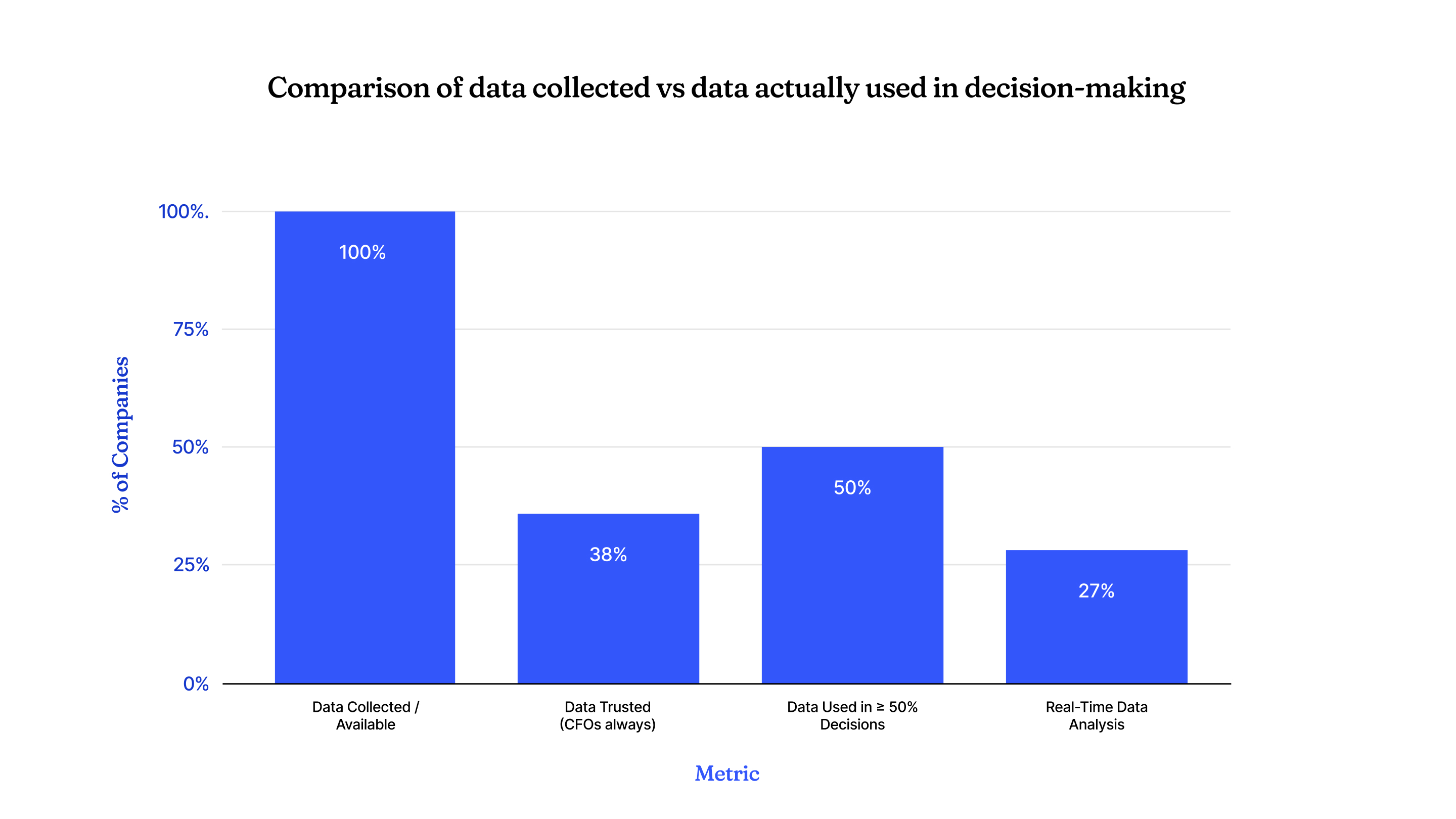
Companies today collect mountains of data – from sales figures and supply chains to customer feedback and ESG metrics – but translating it into strategy remains tough. In practice, many firms underutilize their own data. A global CFO survey found that only about 38% of finance leaders said they always trust their data, and barely half report making even half of their decisions based on data. This trust gap means insights often fall through the cracks. Leading firms, however, set themselves apart by aligning executives around clear goals and tracking the right signals. McKinsey reports that companies in the top quintile of growth were 2.5 times more likely than others to fully align on their competitive advantages and to monitor those advantages at the market level.
 Emerging technologies have accelerated the knowledge glut. AI tools and FinTech platforms generate analysis and recommendations at scale, making advanced outputs widely available. For example, IMF data show that digital financial services usage has exploded – mobile and online transactions per person have grown roughly fivefold in emerging markets since 2017. Similarly, a recent McKinsey survey finds 88% of organizations report using AI in at least one function. However, most are still in pilot mode: only about 39% report significant enterprise-level impact on productivity or profits. This gap highlights the scarcity of insight, not raw output. Widespread algorithmic signals are now table stakes; the premium belongs to those who critically vet and strategically apply AI/FinTech outputs. Without human judgment and context, even the best AI forecasts or big data models can mislead.
Across regions, data abundance varies, but the need for insight is universal. Emerging economies have made remarkable strides: for instance, digital transactions (mobile money and banking apps) in Africa and Asia have surged. Yet richer access has not automatically translated to smarter decisions: countries and firms alike struggle to analyze data strategically. Even as emerging markets leapfrog with technology, they face similar challenges of turning data into policy and business insight. In mature markets, fragmented news and policy shifts also create noise. In all contexts, the competitive winners will be those who invest in extracting clarity – for example, through better analytics teams and governance frameworks that turn raw data into targeted knowledge.
In summary, raw knowledge is now ubiquitous – but meaningful insight remains rare. This shifts the competitive moat from data ownership to insight capability. Across finance, industry, and tech, the leaders will be those who can swiftly distill accurate intelligence from complexity and execute boldly. McKinsey’s research underscores this point: companies that explicitly track their unique advantage and relevant signals are far more likely to outperform peers. Likewise, experts emphasize that success in the digital era comes from converting inputs into decisions that customers can feel. As one industry analyst put it, firms must choose to “convert inputs into decisions” rather than just “feed the machine” with data. Moving beyond information overload to genuine insight – through skilled people, disciplined processes, and smart use of AI – will be the rare asset that drives outcomes in the years ahead.