



The Paradox Nation: Why Africa’s Biggest Oil Producer Cannot Fuel Its Own People
April 1, 2026 by johneb492254456
Nigeria produces Africa’s most oil, about 1.6–1.7 million barrels per day in 2025, yet it still struggles to keep fuel flowing to its own citizens. The country exports crude while importing refined petrol, a disconnect that became glaring with the 2023 opening of Dangote’s massive refinery. Despite this new capacity, Nigeria spent roughly $10 billion on gasoline imports in 2025. In practice, even Africa’s largest oil economy “cannot refine enough to meet its own needs,” as one analysis puts it. Nigeria now buys much of the petrol its citizens need, even as it sells the crude oil it produces. The core of the paradox is that access to oil does not equal access to fuel. Top executives like Aliko Dangote have warned that Nigeria’s reliance on imported refined products leaves it vulnerable to global shocks.
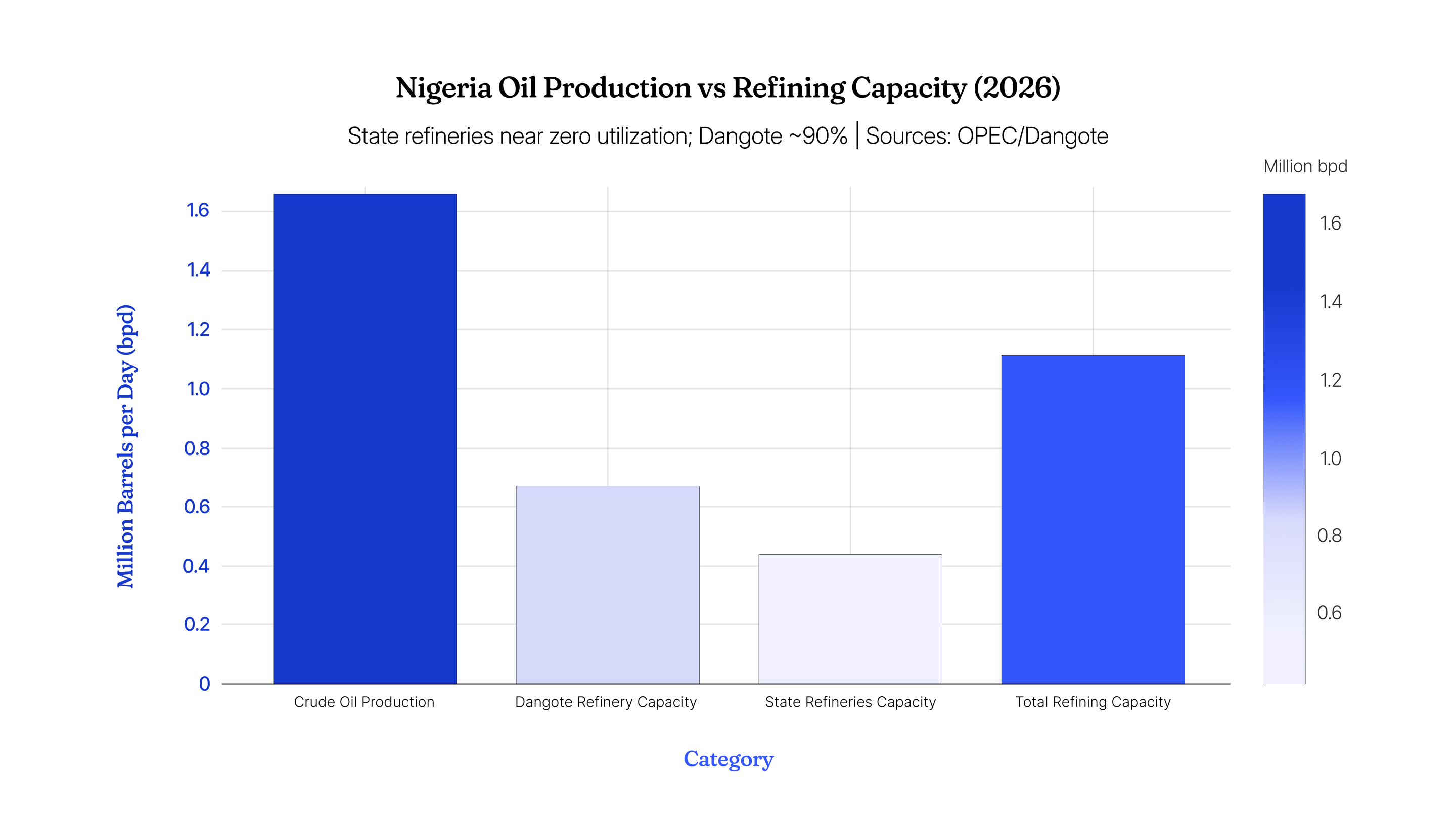
On paper, Nigeria has significant refining capacity. Its oil fields produce about 1.63 million barrels per day, making it Africa’s top producer. However, domestic refining is concentrated in the new Dangote refinery (650,000 barrels/day) and a trio of state-owned plants (Port Harcourt, Warri, Kaduna) that together have 445,000 barrels/day capacity. Crucially, all three state refineries are effectively offline today. Dangote’s plant in Lagos is the world’s largest single-train refinery (650,000 bpd), but it only began feeding Nigeria’s market in late 2023. The legacy refineries built in the 1970s have long suffered from neglect. Official reports in 2026 confirm that Port Harcourt, Warri, and Kaduna produced virtually zero petrol in recent months. In effect, Nigeria has “capacity” it can’t use, and lacks the operational refining needed to turn most of its oil into fuel for Nigerians.
 Even so, Nigeria’s total petrol consumption exceeds 50 million liters per day. BusinessDay data for early 2026 shows Dangote’s output covering around 36–40 million liters/day, while overall supply (including any local and import) was still roughly 50–60 million L/day. In other words, Dangote meets only about 40–50% of demand at best. The rest continues to come from imports. Industry reports estimate that over 60% of Nigeria’s gasoline consumption in 2025 was imported fuel. That means despite Dangote’s scale, Nigerians continue to queue for petrol as if the country were a net importer. This is the essence of the paradox: an oil boom has arrived, yet the pump still looks to overseas.
Why can’t Nigeria’s oil refine itself into fuel? The roots are institutional as much as technical. The three state-owned refineries remain idle for want of investment and maintenance. Government data show no petrol output from Port Harcourt, Warri or Kaduna in recent months. The pipelines and equipment sat unused while fuel imports continued. Earlier attempts to jump-start local refining have stumbled. In late 2023, President Tinubu announced a 15% fuel import tariff to spur local supply, but it was swiftly cancelled when it became clear domestic production was insufficient
This paradox carries a heavy economic cost. In 2025 Nigeria exported roughly $31.5 billion in crude oil revenues, but spent about $10 billion on fuel imports. That means roughly one-third of oil export earnings were offset by buying back petrol at world prices. Put differently, each barrel of crude sold abroad is nearly half a barrel’s worth of expensive imported gasoline. This mismatch pressures Nigeria’s balance of payments and currency. Even as the current account remained positive thanks to high oil prices, reliance on imports leaves the naira vulnerable to swings in global markets. It also burdens consumers: fuel that should be “owned” by Nigerians instead drains foreign reserves.
For ordinary Nigerians, the fuel paradox means volatility at the pump and in power supply. As global oil prices surged in 2025–2026, local petrol prices climbed sharply, adding to Nigeria’s stubborn inflation. Small businesses and transporters – who rely on petrol and diesel generators – have started passing higher fuel costs onto consumers, driving up food and commuter prices. Aliko Dangote has been blunt about the risks: he warned that continued Middle East tensions and higher oil prices could spur another wave of inflation across Africa. He even mentioned that governments might be forced into emergency measures – such as encouraging remote work or shortened hours – to curb fuel demand, echoing pandemic-era policies.
Solving Nigeria’s fuel paradox requires tough choices. The government has signaled steps to revive the state refineries. In early 2026 NNPC announced plans to seek partners to rebuild Port Harcourt, Warri and Kaduna – restoring a combined 445,000 bpd capacity. It’s also planning a 10,000 bpd condensate plant in Edo State.
But analysts caution that policy must align. A recent CBN report notes Nigeria imported “N5.7 trillion” of crude in 2025 despite a policy to swap local oil for foreign exchange. In practice, Dangote and modular refineries still import the majority of feedstock. Critics say the naira-for-crude scheme has “yielded minimal results” so far. Until reforms ensure that Nigeria’s own oil flows into its refineries (not off to the highest bidder abroad), the cycle will repeat.
In conclusion, Nigeria’s paradox is not a natural law but a policy failure. The country has the resources to fuel its economy, but needs coordinated investments and market reforms to unlock them. Only then can Africa’s top oil nation stop “buying the petrol it cannot afford” and actually use the oil it produces.