



The Biggest Hedge Fund Sell-Off in 13 Years Just Hit Goldman’s Prime Book
April 8, 2026 by johneb492254456
Goldman Sachs’ prime brokerage data show hedge funds jettisoned equities at the fastest rate since 2013. In March, managers sold global stocks for the 4th consecutive month at the quickest pace in 13 years, dwarfing flows seen in any post-Covid rally (apart from last June’s “Liberation Day” spike). By late March, net selling had reached multi-week highs not seen since April 2025. This wholesale liquidation spanned regions and sectors: from U.S. tech to Asian markets, fund managers were exiting en masse in response to Iran-war volatility. The S&P 500 and global indices slid as this selling pressure built.
The selling wasn’t uniform. Goldman’s flow notes show hedge funds turned decisively bearish on U.S. and Asian stocks while betting Europe would hold up better. Over the latest week (to March 19), global funds sold stock index products and single equities across all regions, but net flows into Europe turned positive – the first notable tilt into European indices in months. In the U.S., the toughest hits came in Consumer Discretionary, Tech, and Financials, where longs were dumped and shorts added. In contrast, staples and energy stocks were rare bright spots, as hedge funds increased longs there expecting safety. Emerging markets were also sold off. This sector/regional rotation means that a future rally might favor the very assets now neglected – a mirror image of today’s pain.
The scale of this purge has set off classic capitulation alarms. Goldman reports that short positions in European macro stocks hit 11% of total exposure – a 10-year high. In plain language, funds are betting record amounts that European stocks will fall. In the U.S., the six-week cumulative net selling is now among the largest in a decade, approaching levels last seen during the Covid crash. Such extremes suggest most weak longs are gone – a typical “exhaustion” state. When hedge funds as a group move to all-short or massively underweight, history says the downside may be limited. Indeed, previous episodes (March 2020, late 2018, etc.) saw similarly ominous positioning promptly followed by furious rebounds once selling pressure eased.
It wasn’t just discretionary managers leaning out; systematic strategies have also been dumping risk. Trend-following CTAs and risk-parity funds de-leveraged as volatility surged, meaning automated models cut positions across stocks, bonds and commodities. While detailed stats are proprietary, Goldman notes that systemic selling by quant funds amplifies market moves. Put simply, as markets fell, algorithms sold to stop losses, reinforcing the cycle. The result: even normally “anticorrelated” strategies like trend CTAs were net sellers, not buyers, of equities. This mechanical deleveraging has compounded the chaos – and it often ends suddenly when models hit limits.
Every panic has a mirror. Goldman explicitly notes today’s net-selling is approaching the depth of March–April 202 (Covid lockdown) and even the Oct 2018 sell-off, though still shy of last June. In those analogs, markets snapped back dramatically. For example, after the March 2020 trough, the S&P 500 rebounded 35% in just weeks once buyers returned. Similarly, the 2011 European crisis saw a 20% bounce when fears eased. The pattern is clear: when herd psychology shifts from extreme fear to cautious optimism, short-covering and bargain-hunting can quickly drive a powerful rally.
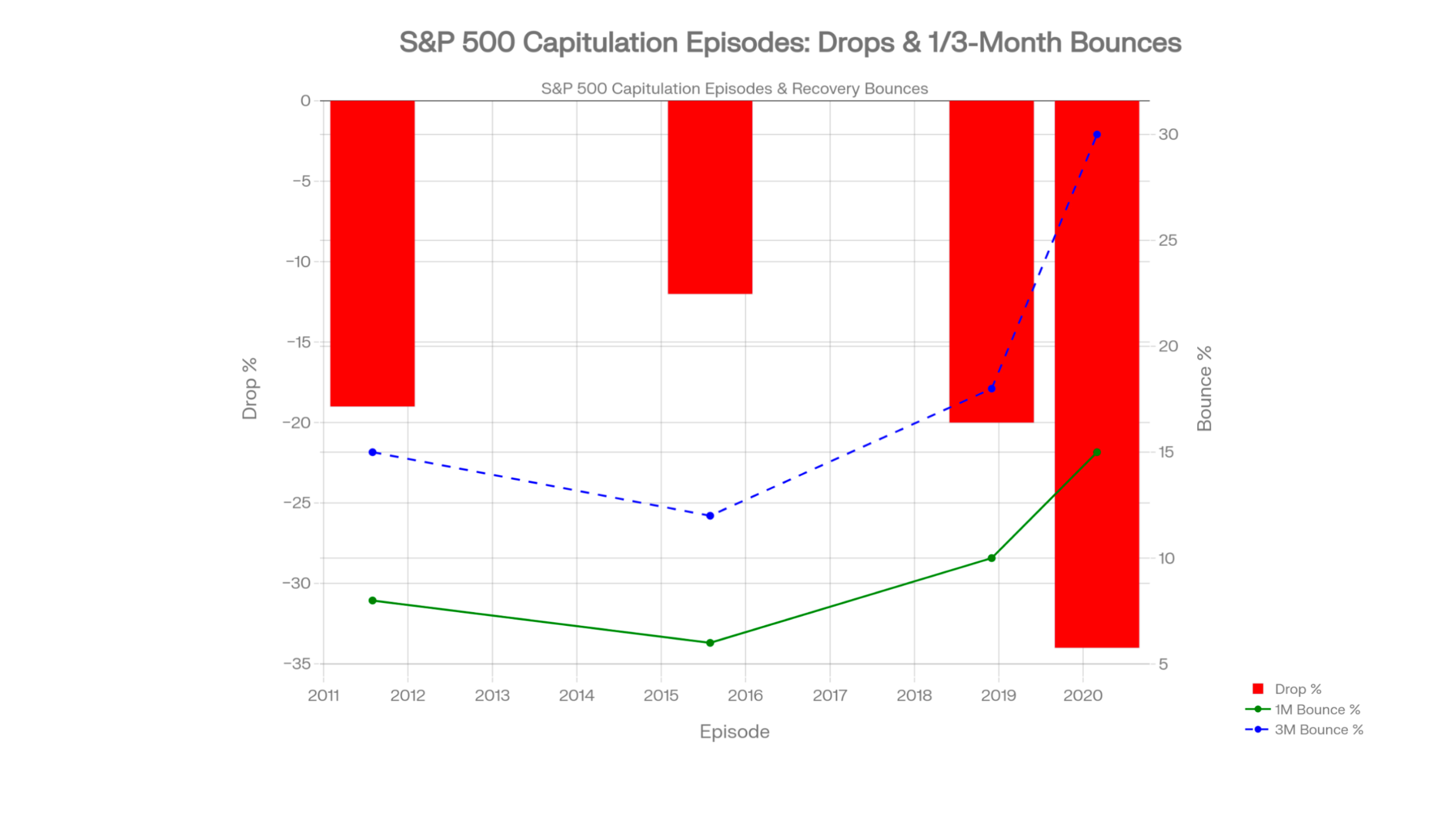 Goldman’s traders warn that all this gloom sets the stage for a “violent” rebound if even a partial peace emerges. With so many positions bets on a crash, any hint of de-escalation could trigger a short squeeze. Bloomberg highlights that “heavy short sales by hedge funds and disposals by systematic investors have increased the potential for a sharp swing higher” if conflict news turns positive. In practice, this means that a minor ceasefire announcement or diplomatic breakthrough might send buying algorithms and short-covering flows into overdrive. Investors should prepare for swings: the initial rally could be steep and fast, potentially overshooting as stop-losses trigger more buys.
Caution is still warranted. Historically, the first bounce after extreme selling can be a bull trap. If war tensions remain high or news disappoints, today’s buyers may find their gains evaporating. For instance, markets briefly rallied on rumors of peace talks last June before falling back. Goldman and other analysts note that “the first peace rally reverses fastest” in past crises. In other words, traders who rush in on the first green candle can get stuck when shorts reassert control. The advice: let any rally prove itself (e.g. sustained volume, break of key resistance) before committing fully. The worst outcome would be buying at the top of a relief rally that falters, requiring another round of selling.